
This page contains an explanation for each of the shutdown countdown steps listed on the previous page.
Under these headings:
| No. | Timing – weeks to shutdown start | Activity | Responsibility |
| 1 | -18 wks | Check for conflicting activities | Shutdown Manager |
The Shutdown Manager should contact the appropriate industry associations and major and specialty contractors to assess the probability of conflicts for resources. He should also contact the local information center or check with local hotels to ensure that there are no conflicting local events which may reduce the availability of accommodation for temporary tradespeople and contractors.
Where there is a potential for a significant conflict, the Maintenance Manager should be advised immediately and appropriate action taken.
| 2 | -18 wks | Issue notice for initial shutdown meeting | Shutdown Manager |
Send out a notice for the initial shutdown planning meeting with an agenda (see item 3).
| 3 | -17 wks | Initial shutdown meeting | Maintenance and Operations Managers with other key managers and staff |
This meeting should be chaired by the Maintenance Manager and attended by the following, as applicable:
- all maintenance staff,
- the Operations Manager, his superintendents and supervisors
- the Engineering Manager
- the Technical Manager
- the Reliability Manager
- the Accounting Manager
- the Storeroom Manager
- the Purchasing Manager
- a plant security representative
- the Safety Manager
The purpose of the meeting is to officially start the detailed shutdown planning process and to communicate the specific requirements to be met to those involved.
The following information should be communicated:
- the starting date of the shutdown
- the starting day of the shutdown (i.e. will the shutdown and start-up times be established to avoid or include weekends, based at this point on the budgeted shutdown duration).
- the operating areas to be shut down
- the available budget and its preliminary distribution across all operating departments
- the contingency allowance to be used in developing work lists
- any major capital work to be included in the shutdown.
- any large maintenance projects or projects with long lead times.
- any unique restrictions or factors for this specific shutdown (e.g., if a production curtailment is likely, there may be instructions to avoid overtime, temporary employees and/or contractors and other measures to minimize costs).
The agenda should include a review of the decisions and actions resulting from the general review meeting for the previous shutdown. The shutdown check list should have been revised where necessary to avoid repeating problems.
The agenda should also include a review of key shutdown milestones and the identification of those responsible for key activities, in particular:
- the Shutdown Manager
- the Operations Shutdown Coordinator(s). It may be desirable to have one Operations Shutdown Coordinator from the production area and one from the utilities area, for example.
- the Electrical Coordinator
- the Preventive Maintenance (PM) coordinator
- the Storeroom Coordinator
- the Contracts Coordinator
- the Health and Safety Coordinator
- the Environmental Coordinator
- the Plant Security Coordinator
As with all shutdown (and other) meetings, minutes should be kept and all decisions and action items, together with responsibilities and completion dates, should be included in the minutes. All minutes should be distributed no later than the end of the day following the meeting.
| 4 | -16 wks | Prepare work requests for long lead-time projects | Maintenance and Project Engineers |
Maintenance and Project Engineers (and others) should submit funding requests for shutdown projects which require purchases with more than 11 weeks lead time at this point. Work on these projects may have started as early as the end of the previous shutdown.
| 5 | -16 wks | Major work – prepare critical paths | Maintenance and Project Engineers |
Maintenance and project engineers should prepare a critical path schedule for each major job well in advance of the start of the shutdown planning process, with input from potential contractors if appropriate. The draft project schedules for this critical work should be complete at this point and should be reviewed with the area superintendents (operations and maintenance), the Operations and Maintenance Managers and the Shutdown Manager.
The length of the shutdown will normally be dictated by the length of the longest single job, which should be planned to progress around the clock in the most efficient manner possible. At this point in the planning process it should NOT be assumed that the shutdown will be the length that is indicated in the plant’s annual operating and maintenance budget.
| 6 | -16 wks | Vibration and other NDT inspections | PM Coordinator |
This is to ensure that all possible failures are detected early enough for corrective maintenance work requests to be included in the shutdown work lists. Typical inspections include vibration measurements and infra-red surveys.
| 7 | -16 wks | Prepare shutdown engineering inspection lists with work order requests | Maintenance Engineers |
The Maintenance Engineers should prepare a list of shutdown inspections to maintain the vessel and other inspection programs in their area. Where these are for internal inspections of process vessels, the vessel-entry procedures (or revisions) required to do this work should also be submitted for approval.
| 8 | -16 wks | Submit all shutdown work requests | All Operations, Engineering, Maintenance and Technical staff |
A message should be sent to all Maintenance, Engineering, Operations and Technical staff advising that shutdown planning has started and all work requests for shutdown work should be submitted and approved within the next three weeks.
NOTE – ALL shutdown work, including contracts and capital work, should be covered by shutdown work orders.
| 9 | -16 wks | Identify area service outages | Electrical and Mechanical Superintendents |
The Electrical and Mechanical Superintendents should prepare a list of required service outages and distribute it to the Shutdown Manager, Operations Shutdown Coordinators and all Area Planners. This list should be based on scheduled preventive maintenance work and other work orders.
Maintenance work on electrical, water, air, effluent and other services may have a significant impact on other planned maintenance activities.
| 10 | -16 wks | Generate preventive maintenance work orders | Area Planners |
All preventive maintenance (PM) work orders for the shutdown areas should be generated from the maintenance computer system. Shutdown PM work orders which may become due shortly after the shutdown (up to three months for annual shutdowns) should be included. These PM work orders should be added to the draft shutdown list.
| 11 | -16 wks | Print draft shutdown list | Area Planners |
This is a printout of the list of all outstanding shutdown work in the areas to be shut down, including PM work orders.
| 12 | -16 to -14 wks | First check of shutdown list | Area Planners and Operations Shutdown Coordinator |
Planners and the Operations Shutdown Coordinator(s) should review the shutdown work order backlog and eliminate any duplicated, completed or cancelled work orders and work which is definitely a low priority (as agreed with the Maintenance and Operations Superintendents). They should ensure that the list is suitable for use for continued shutdown planning. No PM work orders should be deleted without agreement from the PM Coordinator (mechanical or electrical).
At this point it is appropriate to consider removing work which could be completed during small planned area shutdowns, although it may be cost-effective to include some or even most of this work in the major shutdown.
As each work order is reviewed, ensure that electrical and other support trades’ involvement in mechanical work (and vice versa) is included on the work order no matter how small this involvement may be.
An essential part of this step is to ensure that each work order has a rough (+/- 30%) estimate of material and labor costs to allow a first estimate of total shutdown cost to be made. NOTE – This is not detailed planning, but a quick review and educated best guess at the job cost by experienced people.
This step should include a tour of all jobs on the draft shutdown list to verify their validity and to assign priorities, so that the process of reducing the work scope to meet the budget will result in the most important work being done.
| 13 | -15 wks | Start weekly updates | Maintenance Superintendents |
To keep the shutdown planning process in the forefront, the Shutdown Manager should report progress, issues and resulting actions each week at regular maintenance and operations department meetings.
| 14 | -15 wks | Determine shutdown duration | Maintenance and Operations Managers |
The mill management should review the budget and the schedule for large and potentially critical jobs, and make a final decision on the starting date and length of the shutdown. This may require some economic analysis to minimize the total cost of lost production plus the cost of maintenance. Budgets should be flexible and integrated to allow this optimization without penalizing any department.
After this meeting the shutdown starting and ending dates should be communicated and any change to these critical dates after this point should be approved by both the Maintenance Manager and the Operations Manager.
If the shutdown starting date changes from the original budget, the check for conflicts (item 1 above) should be repeated.
| 15 | -15 wks | Shutdown communication | Maintenance and Operations Managers |
The Maintenance and Operations Managers should issue a memorandum to all employees giving the information on the shutdown which will personally affect them, including the shutdown dates, the work schedules to be followed, overtime to be worked and the availability of time off during the shutdown and shutdown preparation periods.
It is especially important to include shift supervision and operators in shutdown communications.
| 16 | -15 wks | Contact temporary tradespeople | Human Resources |
Letters or other communication should be sent to all acceptable temporary tradespeople advising them of the shutdown date and requesting advice on their availability. No commitment for work should be made at this point.
| 17 | -15 wks | Contact temporary staff | Maintenance Manager |
A similar communication should be sent to potential temporary supervisors, schedulers, planners, engineers and other staff support.
| 18 | -14 wks | Eng inspection work orders approved | Managers |
All work orders for engineering inspections should be approved at this point. Maintenance Engineers should notify the PM coordinator of all planned contract NDT inspections.
| 19 | -14 wks | Check and correct work order coding | Area Planners |
The Area Planners should review all jobs on the draft work list and check and if necessary correct work order codes and equipment numbers.
| 20 | -14 wks | Issue first draft of work list | Shutdown Manager and Area Planners |
The Shutdown Manager should issue the first draft of the shutdown list and also run a work order cost report on this list to allow the estimated total cost of the shutdown to be compared to the budget. These lists should be distributed to Maintenance Superintendents accompanied by a memo showing the cost of the listed work and the budget and contingency allowance for each area, with a request to adjust the scope of the work to meet the targets within the next two weeks, where necessary.
It is of value if this draft listed is sorted by priority in each area.
| 21 | -14 to
-12 wks |
Revise work lists to meet budget | Maintenance Superintendents, Supervisors, Planners, PM Coordinator, Engineers and Operations Superintendents |
A number of meetings should be held with Maintenance and Operations Superintendents to revise the shutdown list so that it meets the budget and contingency guidelines. Work that remains on the list should be validated to ensure that it is still required and that the scope is correct. Priorities for all work orders should be updated.
No PM work orders should be removed from the shutdown list without the agreement of the PM Coordinator (electrical or mechanical).
The prioritization of maintenance work should be based on the risk of breakdown prior to the next scheduled shutdown when the work could be done. The Operations and Maintenance Managers should be advised if it appears necessary to cancel any work which may threaten the achievement of the plant’s reliability goals. It may be necessary to reassign spending between departments to balance plant-wide priorities or additional funding may be required.
A cost report should be run frequently during this process to determine how well the total work scope matches the budget. NOTE – allowance should be made for the later addition of shutdown resource work orders (item 36 below).
| 22 | -12 wks | Arrange accounting assistance | Accounting |
Ensure that appropriate management accounting staff are available for the shutdown period to assist with cost tracking.
| 23 | -12 wks | Issue revised work list | Shutdown Manager |
The revised shutdown list should be issued to all Maintenance and Operating managers, superintendents and planners. This list should now meet the budget and contingency guidelines. The list should be sorted by operating area, with page breaks at each change of area. A list of work which has been deleted from the original list should be attached.
| 24 | -12 wks | Establish contract work list | Maintenance and Project Engineers and Shutdown Manager |
The list of contract work should be established at this stage to allow full advantage to be taken of a competitive bidding process. Engineers and others responsible for contract work should have input and be copied when this list is available. There may be savings in combining a number of independent jobs under a single contract.
Overall management and coordination of contract work should be assigned to one person, called the “Contracts Coordinator”.
| 25 | -12 wks | Prepare request for shutdown funding | Shutdown Manager and Maintenance Engineers |
Major shutdowns are expensive events and may require special approval. A funding request should be prepared to cover the total shutdown cost, with costs broken out by area.
Large projects on the shutdown list should each have work order numbers and sub-work orders to allow their costs to be properly managed. For each of these projects, the annual budget and estimated costs should be included. If the total estimate on the shutdown funding request is different from the budget, a variance statement explaining the reason for the difference should be included.
With good budgeting and planning, the shutdown funding request should be a brief document (1 to 2 pages) and contain no surprises.
| 26 | -12 to -10 wks | Detailed job planning | Area Planners |
Detailed planning of all shutdown work should be completed during this period, by the Shutdown Manager and Area Planners. Of course, many work orders may have been planned well before this date. As estimates are refined, the content of the work lists may need to be adjusted to match the budget. At the end of this period, all longer-delivery work order materials should be on order and work information packages completed.
| 27 | -11 wks | Approve shutdown funding request | Managers |
The funding should be approved at this point to avoid delays in deliveries and in commitments to contractors.
| 28 | -10 wks | Issue preliminary shutdown schedule | Shutdown Manager and Operations Shutdown Coordinator |
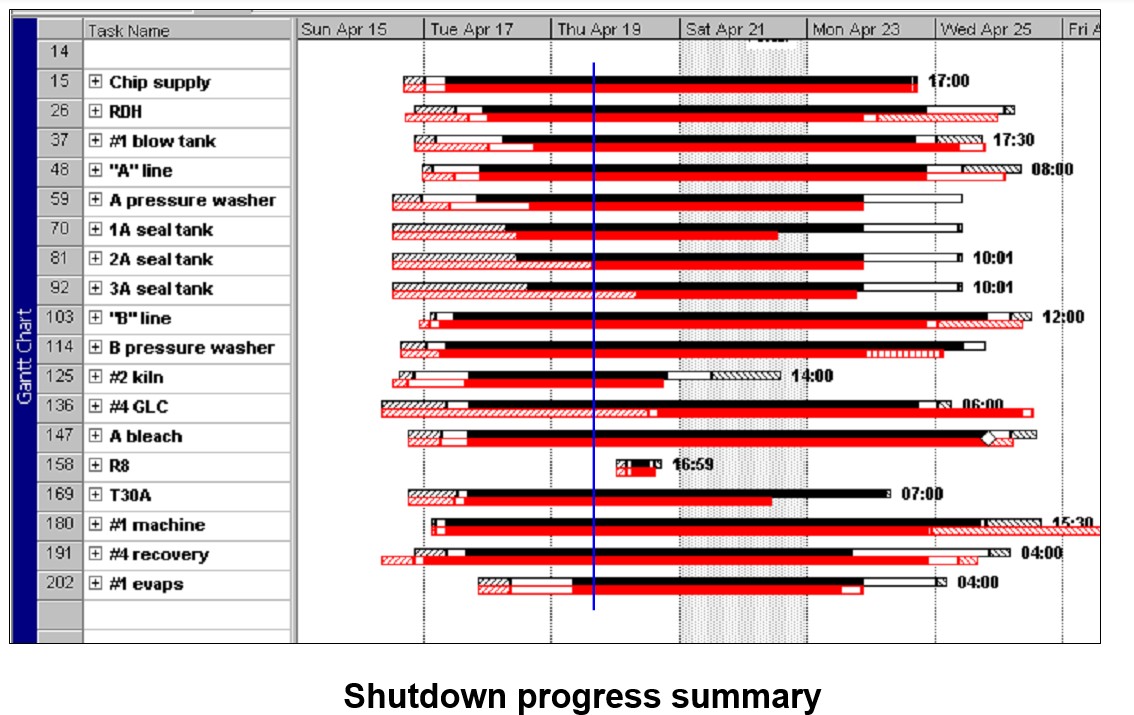
A summary bar chart showing shutdown, lockout, maintenance, de-locking and start-up times should be prepared by the Shutdown Manager, with input from the Operations Shutdown Coordinator, Maintenance Engineers, Planners and others with scheduling information. The overall shutdown and start-up times should be based on the times for the critical area, i.e. the plant area with the longest single job.
The following example uses different bar patterns to show shutdown times (draining, cooling, cleaning, etc), lockout and isolation, maintenance, de-locking and de-isolation and startup (filling and heating vessels, etc). The vertical blue line shows the current time (5 pm Thursday). The top bar for each area shows the original schedule. The bottom bar shows the actual times for events in the past and the latest estimate for events in the future.
A separate line is required for each major area and for all potentially critical work orders. This format should be used for reporting shutdown progress, as it can be displayed on a screen or posted at shutdown meetings to communicate overall shutdown progress.
If additional detail is required then this should be covered in separate schedules, which may be linked to the summary schedule.
| 29
|
-10 wks | Notify the Storeroom of miscellaneous material needs | Area Planners |
Planners should provide the Storeroom with a list of standard consumable materials (bolts, gaskets, welding rod, etc) that will be required for the shutdown. A standard list should be kept on file, with items and quantities updated after each shutdown. Input is required from Area Planners.
| 30 | -10 to -8 wks | Material ordering | Engineers and Area Planners |
Material purchasing should start as soon as the shutdown funding is approved, and may continue up to two weeks before the shutdown, all based on delivery times to ensure all material is on site at least one week in advance of the shutdown.
| 31 | -10 wks | Issue shut-preparation work list | Area Planners |
This work list should include preparation work for each shutdown work order. It is especially important to include cleaning and other activities which should be coordinated to minimize costs. Planners should prepare these lists, and it may be of value to assign the coordination of specific activities, e.g. the erection of all scaffolding, to one planner.
Pre-fabrication and other pre-shutdown work must be given priority by operations and maintenance supervisors, and it may be necessary to employ additional resources to ensure that this work is completed in advance of the shutdown start date.
| 32 | -10 wks | Plan safety inspector coverage | Safety Manager |
The Safety Manager should arrange for a safety inspector(s) and provide coverage for all shifts to be worked. If operating employees are to be used for this function, the operations scheduler should be advised of the names and dates to allow relief to be arranged.
| 33 | -10 wks | Union-management meeting to discuss contracting | Contracts Coordinator |
Where an agreement to review the employment of contractors with the union local is in place, a meeting should be held at this point to discuss potential contract work. The Shutdown Manager and the owner’s representatives should provide information on all contract work to the management members of the committee prior to this meeting.
| 34 | -10 wks | Establish manpower distribution between areas | Maintenance Superintendents |
The distribution of maintenance manpower should be agreed at a meeting of the Maintenance Superintendents and supervisors. Some movement of specialist skills between areas may be beneficial, especially if temporary tradesmen and/or contractors are to be used.
| 35 | -10 wks | Establish maintenance shifts | Maintenance Superintendents |
Shifts to be worked should be decided by the Maintenance Superintendents with input from the Operations Shutdown Coordinator, and these should take into account critical-path work, critical-path maintenance equipment (e.g. overhead cranes), interference between jobs, demands of the operating plant and the type of work to be done (e.g. a night shift of temporary tradesmen may be appropriate if they have good supervision and the job[s] do not require detailed knowledge of the plant and its systems). The availability of special equipment (e.g. balancing machines and laser alignment units) may also dictate the use of night shifts.
| 36 | -10 wks | Work orders for shutdown resources | Shutdown Manager |
Work orders and purchase orders should be prepared for miscellaneous outside services to ensure that all costs are included in the shutdown tracking process. Typical shutdown resources include cafeteria and camp management, safety-watch for vessel entry, gas testing, night shift clean-up, elevator and crane operators, etc. These resources should be identified on each work order, where appropriate.
| 37 | -10 wks | Assign contractor responsibility to engineers and others acting as “Owner’s Representatives” | Contracts Coordinator |
Clear responsibility for all contractors on site is essential, and should be communicated to all involved in the shutdown. The role of “Owner’s Representative” for specific work or contracts carries responsibility for work safety and those assigned this role should be properly trained to understand and carry out the many important administrative and management functions required.
It may also be a legal requirement that one qualified person be designated as the health and safety coordinator, with the responsibility to ensure compliance with the appropriate regulations.
Responsibility for contractors on the night shift must also be assigned.
| 38 | -10 wks | File Notice of Project | Shutdown Manager |
A Notice of Project (or equivalent) may be a legal requirement and should be filed with the local industrial health and safety authority. It may also be prudent to keep this authority involved in the shutdown planning process, through the Joint Union/Management Health and Safety Committee where applicable.
| 39 | -10 wks | Prepare bid packages | Engineers |
The preparation of bid packages for all contract work should start at this point. Careful attention should be given to selecting the appropriate form of contract (time and materials, firm price, etc) for each project or group of projects. For critical work, contracts should include strong incentives (bonus/penalties) to meet the schedule.
| 40 | -10 wks | Notify Plant Security | Area Planners and Contracts Coordinator |
The safety and security managers must be advised of the number and types of safety locks required, the induction schedules for temporary employees and contractors, traffic control requirements, additional security, road closures, hot work inspections and any other activity requiring their planning and preparation.
| 41 | -10 wks | Final shutdown cost review | Shutdown Manager, Accountant, Maintenance, Engineering and Operations Superintendents, Operations Shutdown Coordinator |
At this point, immediately prior to freezing the shutdown work list, the Maintenance and Operations Superintendents, with the Maintenance Manager, Operations Manager, Shutdown Manager, Accounting Manager and Plant Manager, should review the final shutdown list with the latest estimate of costs, and commit to the shutdown cost and scope
Two weeks is allowed for this critical step to resolve all outstanding budget, schedule and scope issues.
| 42 | – 8 wks | Freeze the shutdown list | Maintenance Manager |
A notice should be distributed to all maintenance, operations and engineering staff advising them that the shutdown work list is closed. It is recommended that any further requests for work should require the approval of both the Operations Manager and the Maintenance Manager, and should not result in the shutdown cost exceeding the budget (i.e. any addition should be balanced by a corresponding deletion).
The contingency allowance should not be used for late work. Its purpose is to provide funding for scope changes that may be identified from planned inspections during the shutdown.
| 43 | – 8 wks | Secure the shutdown list | Shutdown Manager |
If possible, the shutdown list should be locked in the maintenance computer system, with the Shutdown Manager being the only person with access to make modifications.
| 44 | – 8 wks | Issue final work list | Shutdown Manager |
The final work list should be distributed, with copies posted in maintenance shops, main operations control rooms and the shift supervisors’ offices.
| 45 | – 8 wks | Check cost codes on all WO’s | Area Planners |
This is a final check on work order cost codes to ensure all work is charged to the correct area or project budgets.
| 46 | – 8 wks | Issue bid packages | Contracts Coordinator and Engineers |
All bid packages for contract work should be issued at this point.
| 47 | – 8 wks | Arrange all outside shop repairs | Maintenance Superintendents |
Area Planners and Engineers should provide a list of all outside shop repairs which are not covered by other contracts. Where possible, these should go out for competitive bids, but where the work scope is not known reliable shops should be contacted to commit shop time. Arrangements for on-site handling and transport should be made at this point. Purchase orders for these repairs should include the time schedule.
| 48 | – 8 wks | Hire temporary tradespeople | Human Resources |
Temporary tradespeople should be committed to work at this point, with firm offers of employment. This offer should include the duration of the work (including safety induction), clarify the responsibilities for travel, accommodation and other expenses and should list the tools, etc, which tradespeople are required to provide. The effect of any change in the duration of employment should also be specified.
| 49 | – 8 wks | Hire temporary staff | Human Resources |
Additional supervisor(s) should be hired at this point. The offers of employment should include similar detail to the offers to temporary trades (above).
| 50 | – 8 wks | Assign supervisors to areas | Maintenance Superintendents |
A list of supervisors showing the areas and tradespeople for which they will be responsible and the marshalling areas and times for their crews should be distributed at this point.
| 51 | – 8 wks | List vessel entry procedures required | Operations Shutdown Coordinator |
A list of all vessel entry procedures required should be provided to the Operations Shutdown Coordinator(s) and the area Operations Superintendents with a request for these procedures to be reviewed and updated where necessary. Copies should be sent to the Maintenance Superintendents. A copy of the list should also be sent to the people responsible for gas testing and safety watch and to the Plant Security coordinator
| 52 | – 8 wks | Rent additional radios | Electrical Supervisors |
Because of the high level of activity during a major shutdown, all key people should be easy to contact, and portable radios or cell phones should be provided. If radios are used, it may be advisable to use more than one frequency, appropriately assigned to functions or areas.
| 53 | – 8 wks | Assign lock-out coordinator | Operations Shutdown Coordinator |
One senior operations person (or perhaps one per major area) should be assigned the responsibility for all safety lockouts, and should be readily accessible by radio as locks are being placed at the start of the shutdown. Part of the responsibility of this position is to check all lock-outs as they are placed to ensure that they meet all the requirements.
| 54 | – 8 wks | Update lock-out and isolation procedures | Operations Shutdown Coordinator |
All lock-out and confined space entry procedures to be used on the shutdown should be carefully checked to ensure that they are up to date and have all the necessary approvals.
| 55 | – 8 wks | Issue major work Gantt charts | Maintenance and Project Engineers |
The schedules (normally Gantt charts) for all major and contract work should be completed by the Maintenance Engineers and should show all key milestones, especially shutdown, lockout and delock times. They should also indicate where there is potential conflict for equipment or resources or with other jobs.
| 56 | – 8 to – 6 wks | Prepare mechanical work schedules | Mechanical Planners |
and
| 57 | – 8 to – 6 wks | Prepare electrical work schedule | Electrical Planners |
The work schedules must allocate tradespeople to each job on the schedules, by name and in a format that allows for easy updating as work is completed. The starting and ending time for each job should be shown.
Whether a spreadsheet or a Gantt chart schedule format is used depends on the type of work and the skills and resources available. Generally, spreadsheets are more suitable for managing a large number of independent jobs while Gantt charts using project-scheduling software are necessary where there are dependencies between jobs and activities.
Where work is to be performed by operators, these activities should be scheduled to the same level of detail as the maintenance work schedules and operating and maintenance schedules should be fully integrated.
Scheduled resources should include lubrication and all other support functions.
Where temporary tradespeople are used, their special skills (hydraulics, rigging, etc) should be matched to the work assigned.
This detailed scheduling is an extremely important step in the shutdown planning process should may start as soon as the final work list is issued (-8 weeks). It requires a concentrated effort by one or more experienced and dedicated planner/schedulers, who should be freed of other responsibilities.
Inspection work should always be scheduled at the start of the shutdown, especially where there is a high probability that inspections will reveal corrective maintenance which should be completed during the shutdown and which may affect the overall work scope.
| 58 | – 6 wks | Confirm all safety locks are available | Safety Manager |
This includes all operations, maintenance and contractor safety locks.
| 59 | – 6 wks | Prepare mobile crane plan | Area Planners and Engineers |
and
| 60 | – 6 wks | Prepare house crane schedule | Area Planners and Engineers |
Mobile and, particularly, overhead house cranes may be critical resources in a shutdown. Detailed schedules may indicate the need for unusual measures, such as locating a mobile crane on an operating floor, which may require engineering safety checks for floor loading.
| 61 | – 6 wks | Request temporary services | Maintenance Superintendents |
Temporary services include:
- power and/or phone lines for contractors’ trailers, areas of heavy welding activity and temporary inside or outside lighting.
- lighting, welding power and other services in areas where power outages are scheduled.
- package boilers for steam or hot water.
- compressors for plant air
- etc
| 62 | – 6 wks | Confirm shift crew size | Maintenance Superintendents |
The night shift crew should be able to progress critical work to maintain the schedule, with some reserve for executing additional unplanned (found) work which may become critical. They should also have sufficient resources to handle demands from the operating areas of the plant, where applicable. Consideration should be given to a clean-up crew to ensure that the work areas are clean prior to the arrival of the day maintenance crews each day, and for the Storeroom to stage materials each night for the next day’s scheduled work.
| 63 | – 6 wks | Arrange shift coverage | Maintenance Superintendents |
Plant employees should be canvassed for volunteers for shift work, where practical and where required by labor agreements.
| 64 | – 6 wks | Arrange assistance for Storeroom issues for temporary trades | Storeroom Manager |
If is planned to use a significant number of temporary tradespeople and contractors, it may be of benefit to station a trained person at a computer terminal in the maintenance shops or close to the Storeroom counter to help with entering Storeroom issue requests during the shutdown. This will reduce wasted time and will help ensure that material usage is properly controlled.
This person may also be able to provide administrative assistance to the Shutdown Manager.
| 65 | – 6 wks | Start expediting material purchases | Purchasing |
This process should continue until all shutdown materials are on site. It should include both direct purchases and stock reservations.
Obviously, for long lead-time items, expediting may start earlier than this.
| 66 | – 6 wks | Arrange temporary tool room and equipment rentals | Area Planners and Shutdown Manager |
Temporary tool rooms are often available from a local rental company who should set up and manage their tool supply center at a central location on the plant site.
All rental equipment (compressors, lift trucks, etc) should be identified and reserved at this time.
| 67 | – 6 wks | Prepare and issue the operating inventory plan | Operations Shutdown Coordinator |
The operations inventory plan is critical to maintain the shutdown schedule and to minimize production and chemical losses resulting from the shutdown and to ensure compliance with environmental regulations. One process engineer should be assigned plant-wide responsibility for preparing and revising this plan as operating conditions change approaching the shutdown date. This person may also act as the Environmental Coordinator. Full use should be made of all process-modeling tools available.
| 68 | – 6 wks | Prepare operating plan | Operations Shutdown Coordinator |
The detailed operating schedule is the first draft of the operations shutdown plan. The preparation of the detailed operating information package should start at this time. See item 90 for the content of this plan.
| 69 | – 6 wks | Issue electrical lockout coverage plan | Electrical Superintendent |
This is a schedule showing the assignment of electricians to each electrical center during lockout and de-locking.
| 70 | – 6 wks | Issue list of motor heaters required | Electrical Planner(s) |
Large and high-voltage motors and other equipment which may not stay dry when not in operation should be identified for protection, and heaters should be placed and connected prior to the shutdown start date.
| 71 | – 6 wks | Walk lockouts – final check | Maintenance and Operations Superintendents, safety representatives |
This should be a formal tour of all safety isolation points by both operating and maintenance supervision, and should include a visual inspection of pipe blanks and blinds and other isolating devices to check that they are approved for their intended service.
| 72 | – 6 wks | Contract bids close | Contracts Coordinator and Engineers |
As soon as bids are received, they should be analyzed in detail. Prior to making any decision on contractors, all those involved should meet and look for opportunities to group or revise contracts to minimize costs and delays.
| 73 | – 4wks | All contracts let | Contracts Coordinator and Engineers |
| 74 | -4 wks | Maintenance review meeting | Shutdown Manager with key managers and staff |
Suggested agenda:
- safety;
- supervisor’s areas
- shut down and startup times
- maintenance access times
- preparation work progress
- all aspects of manning
- allocation of manpower
- meals and meal times
- overtime plans
- shift work
- outstanding issues, threats and resulting action plans with names, dates and follow-up actions defined
| 75 | – 4 wks | Issue start-up maintenance coverage plan | Maintenance and Operations Superintendents |
For major shutdowns, additional maintenance coverage, perhaps with a supervisor, may be provided for a few days after start-up. This may need to be increased if the start-up is over a weekend.
The start-up maintenance coverage schedule should be prepared in advance of the shutdown to ensure that it is integrated into the shutdown manning plans. If the start-up schedule changes, resource plans should be revised.
| 76 | – 4 wks | Temporary services in place | Electrical and Mechanical Superintendents |
All temporary electrical and other services should now be in place.
| 77 | – 4 wks | Temporary facilities plan in place | Electrical and Mechanical Superintendents |
A location plan for all temporary facilities (washrooms, locker rooms, etc) should be prepared and posted in the shutdown areas.
| 78 | – 4 wks | Gas testing/safety watch plan in place | Shutdown Manager and Engineers |
One person should be responsible for the coordination of all gas testing and safety-watch, and should be provided with a radio or cell phone for the duration of the shutdown. Night shift supervisors may assume this responsibility on the off shifts. The scheduling of the necessary resources and skills may be complex and it is possible that more than one person will be required to supervise gas testing and safety watch activities. The names of these people should be included in published shutdown documents.
| 79 | – 4 wks | Start weekly preparation work progress reports | Maintenance Supervisors |
To ensure that all work is ready to proceed on the shutdown start date, regular reviews of preparation work should be started at this time and continue until all preparation work is completed, no later than two weeks in advance of the shutdown date. Preparation work can, of course, start as soon as the final shutdown list is published.
| 80 | – 4 wks | Crane, elevator and utilities inspections | Maintenance Supervisors |
All cranes and elevators in shutdown areas should be thoroughly inspected. Other facilities that will be required for maintenance (e.g. local phones, welding outlets, 110v services and air outlets) should also be checked. Consideration should be given to assigning an operator to elevators in heavy maintenance areas to ensure that doors are not left open and elevators are not overloaded or abused.
| 81 | – 2 wks | Final vibration and other NDT inspections | PM Coordinator |
This is a final inspection of equipment with a short failure development period to ensure that all failures are identified in time for corrective work orders to be included in the shutdown scope.
| 82 | – 2 wks | Joint operations/maintenance review meeting | Shutdown Manager with key managers and staff |
Agenda: Review of the overall operating and maintenance work scope, costs and schedule; identify and address all outstanding issues.
| 83 | – 2 wks | Relieve key supervisors for shutdown preparation | Maintenance Superintendents |
Where practical, the supervisors of areas with high work loads should be relieved for 1 to 2 weeks prior to the shutdown to allow them to ensure that all work is properly prepared. In large plants where the shutdown will affect only a part of the operation it may be practical for supervisors in non-shutdown areas to cover their own area plus the operating demands of areas which will be shut down during the shutdown.
| 84 | – 2 wks | Final notice to Plant Security | Shutdown Manager |
Final update to Plant Security on road closures, confined space entries, contractor information documents, etc.
| 85 | – 2 wks | Issue work order packages | Planners |
Work order packages should be issued to the supervisors. These should be complete with all the necessary information regarding parts locations, safety instructions and all the other details that are part of a well-planned work order.
| 86 | – 2 wks | Issue final revisions to operating plans | Operations Shutdown Coordinator |
Issue final revisions to operating schedules, with latest start-up, shutdown and operating work plans, by area and in detail. See item 90.
| 87 | – 2 wks | Implement inventory management plan | Operations Shutdown Coordinator and Shift Supervisors |
At about this time (which will vary depending on the type of operation) process inventories should be managed to ensure that all process, chemical and other storage vessel levels will be at target levels at the start of the shutdown to ensure there is no delay in entering any vessels for planned inspection or maintenance.
| 88 | – 2 wks | Issue final detailed work schedules | Shutdown Manager |
Final revisions to all work lists and schedules should be issued at this time.
| 89 | – 2 wks | Confirm all permits are in place | Maintenance Superintendents and Engineers |
Final check of all work to ensure all necessary permits (pressure vessels, asbestos, fall protection, hot work, excavation, etc) are issued.
| 90 | – 2 wks | Issue information packages | Shutdown Manager |
The operating information package provides detailed instructions to all operators who will be involved in the shutdown. It is often a large document and should include the following:
- specific instructions for detailed cleaning of all items of process equipment which will be maintained during the shutdown
- instructions for managing all in-process inventories prior to the time the plant shuts down
- instructions for managing raw material and finished product inventories
- the time each part of the process is to be shut down
- all lockout and isolation procedures to be places as the plant shuts down, with timing
- instructions for cleaning all process vessels, piping and equipment after it is shut down, with time schedules
- work assignments for all operators during the shutdown. This could include maintenance assistance and should be in the form of work order packages
- a list of all equipment to be given detailed operating checks prior to start-up with scheduled start-up times.
The maintenance information package should include:
- a copy of the shutdown work list and schedule
- maintenance access times (beginning and end) for all equipment
- contact phone or pager numbers for all key shutdown people, including contract supervision.
- a separate list of off-shift contact phone numbers for all contractors’ employees and temporary employees
- a schedule of mobilization and demobilization times for all contractors
- a site map showing the location of all temporary facilities, road closures, contractors trailers, access routes and parking.
- a plant map showing the areas of responsibility for all maintenance supervisors and crews and for all contractors. This should also show areas which are out of bounds during the shutdown
- a current plant local telephone list
- a list of radio channels by area, if required
- a schedule of safety indoctrinations for all contractors and others as required
- a list of the safety locks issued to all contractors and others as required
- up-to-date weather forecasts, as available
| 91 | – 4 wks | Operations review meeting | Operations Shutdown Coordinator |
Attendees should include all operating supervisors and the Shutdown Manager. Suggested agenda:
- safety
- environment protection
- operating crew schedules
- process inventory management
- shutdown/cleaning/cooling schedules
- planned startup times
- isolation and lockout
- “operating maintenance” (i.e. shutdown work to be performed by operators)
- shutdown and start-up coverage
- assistance to maintenance crews
- outstanding issues and action plans
| 92 | – 2 wks | Operating crew meetings | Operations Shutdown Coordinator and Shift Supervisors |
Meetings should be held with the operating crews that will be on shift during the shutdown period to review special operating procedures, lockouts, cleaning and other items included in the information package.
| 93 | – 2 wks | Equipment cleaning | Operations Superintendents |
Cleaning of all equipment prior to maintenance will result in reduced work times and improved quality. This work may be contracted and maintenance should be involved in equipment cleaning where damage could be caused by the cleaning process.
| 94 | – 2 wks | Packages for temporary tradespeople | Human Resources |
When each temporary tradesperson arrives, there should be a package of necessary materials and information available. This should include hat and coverall name tags, locks, personal protective equipment (as per the employment agreement), name of supervisor, reporting location and an information letter confirming the conditions of employment.
Temporary tradesmen must also be provided with lockers and secure storage for their tools.
| 95 | – 2 wks | Crane, elevator and utilities inspections complete | Maintenance Supervisors |
| 96 | – 2 wks | Preparation work complete | Maintenance Supervisors |
| 97 | -1 wk | Rental tool room and rental equipment on site | Shutdown Manager, Electrical Supervisor |
The rental tool room should be set up close to the center of shutdown activity.
All rental equipment should be received, checked for safety compliance and operation and if training is required, this should be conducted.
| 98 | -1 wk | Contractor mobilization | Contracts Coordinator |
If there are several contractors, coordination of their mobilization is required.
| 99 | -1 wk | Temporary facilities in place | Maintenance Superintendents |
Temporary locker rooms, washrooms, etc, should now be in place.
| 100 | -1 wk | Final shutdown meeting | Shutdown Manager with all key managers and staff |
The final shutdown meeting should include all those involved in managing the shutdown, including union representatives, and should be a brief review of the overall plan and include a “round the room” check for outstanding issues and resulting action plans.
The agenda should also include a final brief review of the budget, schedule and work scope, with a last word on safety and environmental protection.
| 101 | -1 wk | Review all jobs with crews | Maintenance Supervisors |
All tradespeople should have the opportunity to inspect and prepare for all jobs that they will be assigned during the shutdown. Initial work order packages should be issued at this point.
| 102 | -1 wk | Safety meetings | Maintenance Supervisors |
Crew meetings should include a discussion on the location and nature of contract work in the area, the special attention required for temporary tradesmen and any unusual or hazardous conditions which the shutdown may create. Engineers and others involved in contract work should be required to participate.
| 103 | -1 wk | Set up safety notices and signs | Maintenance Supervisors |
Temporary notices relating to the shutdown (overhead hazards, road closures, restricted areas, etc) should be located in appropriate places.
| 104 | -1 wk | Temporary staff on site | Maintenance Superintendents |
Temporary supervisors should be given adequate time to fully prepare for the shutdown. This time will vary depending on their prior experience and the scope and nature of their assigned work.
| 105 | -1 wk | Materials staged | Area Planners and Storeroom |
All materials (except where size, probability of theft or damage, etc dictate otherwise) should be located close to work areas and clearly identified with the work order number prior to the start of each job.
Ideally, all shutdown materials should be staged in a secure area (preferably the Storeroom, or at least under the Storeroom’s control) and delivered daily to each work site or nearby drop point.
| 106 | -1 wk | Temporary trades induction | Safety Manager |
Temporary trades safety inductions should not be carried out at the expense of shutdown work. This will normally require that both general plant and area safety inductions are completed prior to the start of the shutdown.
| 107 | -1 wk | Contractor inductions | Safety Manager |
A detailed schedule of contractor safety inductions should be prepared by the Contracts Coordinator and the Safety Manager and communicated to all contractors and their plant contacts.
| 108 | -1 wk | Distribute weather forecasts | Shutdown Manager |
Weather forecasts should be posted daily in the shutdown meeting room, and distributed to those affected by weather conditions.
| 109 | -1 wk | Temporary trades area inductions | Maintenance Supervisors |
Crew safety chairmen should be involved in the area safety inductions.
- SHUTDOWN STARTS
| 111 | Progress tracking | Maintenance Superintendents |
- Cost control. As new commitments are identified, scope change requests should be submitted and purchase requisitions should be entered and approved. All time cards and contractors’ daily force accounts should be submitted to the time office early each morning to allow the previous day’s costs to be reported at the daily review meetings.
- Reporting of job progress and completion. All supervisors should keep the Shutdown Manager advised of progress and completion of all work orders. This can be done by entering this information on the master job schedule in the shutdown coordination centre. Keeping this schedule up to date can be a full-time job for one or more people during a large shutdown, and these resources should be considered in the shutdown planning process.
- Recording of times and issues. The Shutdown Manager and the Operations Shutdown Coordinator(s) should carefully record the actual time of all events which are included on the schedule, especially the time production stops and resumes in each area and the starting and ending of maintenance times (locks on and locks off). All involved in the shutdown should make a note of any issues which may be opportunities to improve future shutdowns.
- Daily shutdown progress review meetings. The agenda should include:
- review of safety and environmental incidents and activities
- follow up on issues from the previous meeting to ensure that they have been adequately addressed
- by area, and starting with operations, then mechanical, then electrical, then engineering – report on work status, adherence to the shutdown schedule and any current issues
- review the shutdown costs vs budget to date
- review of overtime by area
- review the overall shutdown schedule
- “round the room” to identify all issues and planned actions
Issues should be recorded on flip charts, with names and actions, and remain posted until resolved.
As the shutdown progresses, special items should be raised at the appropriate time, e.g., toward the end of the shutdown, reminders should be given to return rentals, complete performance reports on temporary trades and contractors, etc.
There should be an overall tone to these meetings that budgets and start-up times are absolute, not “just targets”. Any indication that budgets may be exceeded or start-up times delayed must be reported immediately and pursued by senior maintenance and production staff. It is essential that all forecasts of costs and schedule are as accurate as possible with neither “padding” nor unrealistic optimism.
If the completion time for the critical path work, or any near-critical work changes, this should be communicated immediately to all involved in the shutdown.
| 112 | 0 | Expedite and inspect off-site repairs | Maintenance Superintendents |
It may be advisable to assign one person to monitor all off-site repair work, and to personally visit each shop frequently to ensure delivery times will be met and to monitor work quality.
| 113 | 0 | Pre-startup checks | Operators |
As each job is completed, the Operations Shutdown Coordinator should advise the operators who should then unlock and check the equipment. As each area is cleared of locks, all equipment should be checked to ensure that it can start up safely and quickly. Checks should include all gland and purge water, equipment rotation direction, valve positions and all other aspects of the operation, and should be recorded in the operating log.
A list of all work done in each area should be given to all operators who will be on shift during the start-up.
| 114 | 0 | Re-torquing, etc | Maintenance Supervisors |
A schedule of equipment requiring additional maintenance during start-up should be maintained and checked off as the work is completed. This is especially important for work done by contractors who may leave before start-up. Checks include re-torquing of flange and manhole bolts, rotation checks, hot line-ups and insulation checks for critical electric motors and equipment.
| 115 | 0 | Final lubrication checks | Maintenance Supervisors |
A full lubrication inspection should be carried out on all maintained equipment, in addition to regular lubrication routines.
- SHUTDOWN ENDS
| 117 | +1 wk | Clean up all work areas | Maintenance Supervisors |
All work areas should be left spotless prior to start up. Clean-up should include the removal of all scaffolding, safety notices and signs and temporary services and facilities required for the shutdown.
| 118 | +1 wk | Contractor demobilization | Contracts Coordinator |
Some additional security coverage may be required for vehicle inspections as contractor materials are removed from the site.
| 119 | +1 wk | Return all rentals | Shutdown Manager |
Ideally, the purchasing process will identify all commitments for rentals so that all rented items can be matched to returns.
| 120 | +1 wk | Baseline measurements | PM Coordinator |
Baseline measurements should include vibration measurements on new, repaired, realigned and balanced machinery and infra-red inspections where insulation, refractory or electrical connections have been repaired.
| 121 | +1 wk | Review temporary trades’ performance | Maintenance Supervisors |
Performance reviews for temporary tradespeople should be included on their leaving slips, and filed in Human Resources.
| 122 | +1 wk | Review contractors’ performance | Contracts Coordinator |
Contractor performance reviews should include the name of the contractor, the site superintendent, the type of work done and comments on safety practices, the quality of work done and productivity.
| 123 | +1 wk | Area shutdown review meetings | Operations and Maintenance Superintendents |
Area post-shutdown review meetings should be conducted within one week of the completion of the shutdown, prior to the general review meeting, and attendance by all area maintenance and operations staff involved should be mandatory. The agenda should include a review of safety and environmental performance, costs, schedule and work scope, with comments on any variances. Recommendations for improvements to the shutdown planning process should be prepared for presentation at the general review meeting.
| 124 | +2 wks | Close all completed WO’s | Area Planners |
All shutdown work orders should be closed within two weeks to allow reporting on adherence to the work plan. As work orders are closed, new work orders should be entered where follow-up work is required.
| 125 | +2 wks | Shutdown performance report | Shutdown Manager |
A formal report on the shutdown should be prepared and issued. This should address the five shutdown key performance indicators, namely safety, environment, budget, schedule and adherence to the work list. A list of additional work done and a list of scheduled work which was not done should also be included. The actions resulting from the area post-shutdown review meetings should be included in this report.
This report should be distributed to all who will attend the general post-shutdown review meeting, at least two full working days prior to this meeting.
| 126 | +2 wks | General post-shutdown meeting | Maintenance Manager with all key managers and staff |
Attendance should include all those listed as attendees for the initial shutdown meeting (item 3). The agenda should be based on the shutdown performance report.
| 127 | +3 wks | Update this check list | Shutdown Manager |
The shutdown check list and instructions should be updated based on the shutdown performance report and on all formal and informal input from staff and tradespeople involved in the shutdown.
| 128 | +3 wks | Complete engineering reports | Engineers |
Technical reports on shutdown inspections and major work completed should be completed and filed in the equipment files, with reference to these reports entered in the history page in the maintenance computer system equipment files. Work orders for follow-up work should be entered, and where appropriate, budget submissions should be prepared.
| 129 | +3 wks | Rebuilds | Maintenance Supervisors |
All equipment rebuilds resulting from the shutdown and which will be returned to the Storeroom should be completed within three weeks, where practical and based on criticality.
| 130 | +3 wks | Prepare for next shutdown | Maintenance Manager |
Budget submissions and work orders for repair work that was identified during the shutdown should be prepared.
Large projects should be managed and scheduled to meet the deadlines in the check list for the next shutdown.
Click here to return to the articles list
Management is getting people to do what you want them to do.
Leadership is getting people to want to do what you want them to do (dsa).
© Veleda Services
Don Armstrong, P. Eng (retired)
President, Veleda Services
dsarmstrong@shaw.ca
250-655-8267 Pacific Time